Israel and Jordan
Weather
| Month | High/Low (°C) | Rain days |
|---|---|---|
| January | 18/10 | 9 |
| February | 18/10 | 7 |
- Sunlight in Tel
Aviv
- Sunrise: 6:39am (24th January), 6:36am (30th)
- Sunset: 5:06pm (24th January), 5:12pm (30th)
- Month with the highest rainfall and humidity (61%) is January
- weather forecasts
Timezone
- GMT+2 current time
Travel Visa
- BN(O) (reference)
- visa-free for 3 months in Israel
- visa on arrival in Jordan
- Visa on arrival obtainable at most international ports of entry and at most international land border crossings (except King Hussein/Allenby Bridge crossing).
- land crossings can take a great deal of time due to long lines in high season and the need to deal with Israeli immigration.
- HKSAR (reference)
- visa-free for 3 months in Israel
- visa on arrival in Jordan
- Visa on arrival obtainable at most international ports of entry and at most international land border crossings (except King Hussein/Allenby Bridge crossing).
- land crossings can take a great deal of time due to long lines in high season and the need to deal with Israeli immigration.
- Entry to the Occupied Palestinian Territories (OPTs) is controlled by the Israeli authorities. You must produce a passport and Israeli immigration slip, to cross between Israel and the OPTs.
Local laws and customs
- You should dress modestly – covering your shoulders, upper arms and legs above the knee - in Jerusalem and the West Bank
- Local residents in ultra-Orthodox Jewish neighbourhoods such as Bnei Brak, Modi’in Illit, Beitar Illit, Beit Shemesh and Safed can react strongly to anyone (particularly women) dressed inappropriately.
- Avoid driving into ultra-Orthodox Jewish areas of Jerusalem on Shabbat (from sunset on Friday to nightfall (approximately 1 hour after sunset) on Saturday). If you attempt to drive into these areas local residents may throw stones at your car.
Money
- Currency
- There are ATMs in Israel and Jerusalem that accept international cards. There are fewer ATMs in the West Bank
- Post offices and banks in Israel and Jerusalem close from midday on Friday to Sunday morning. In the West Bank, they are usually just closed on Fridays.
Places
- map
- Lion’s
Gate
- Wiki
- best to visit super early in the day due to crowd
- Mt of
Olives
- Wiki
- could be visited before sunset
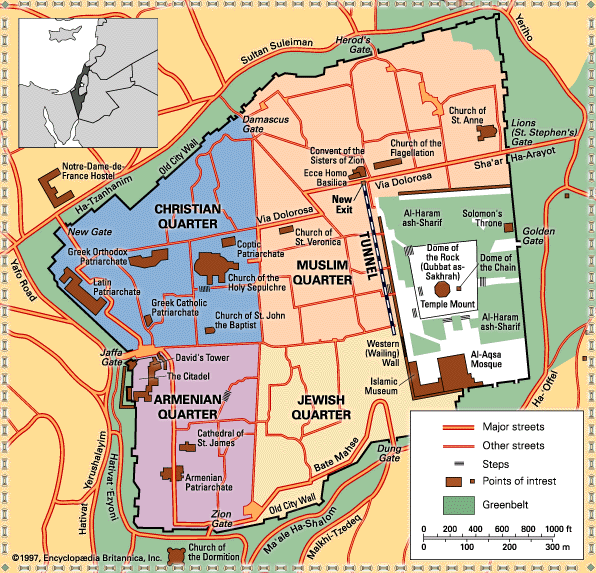
- Old
City
-
-
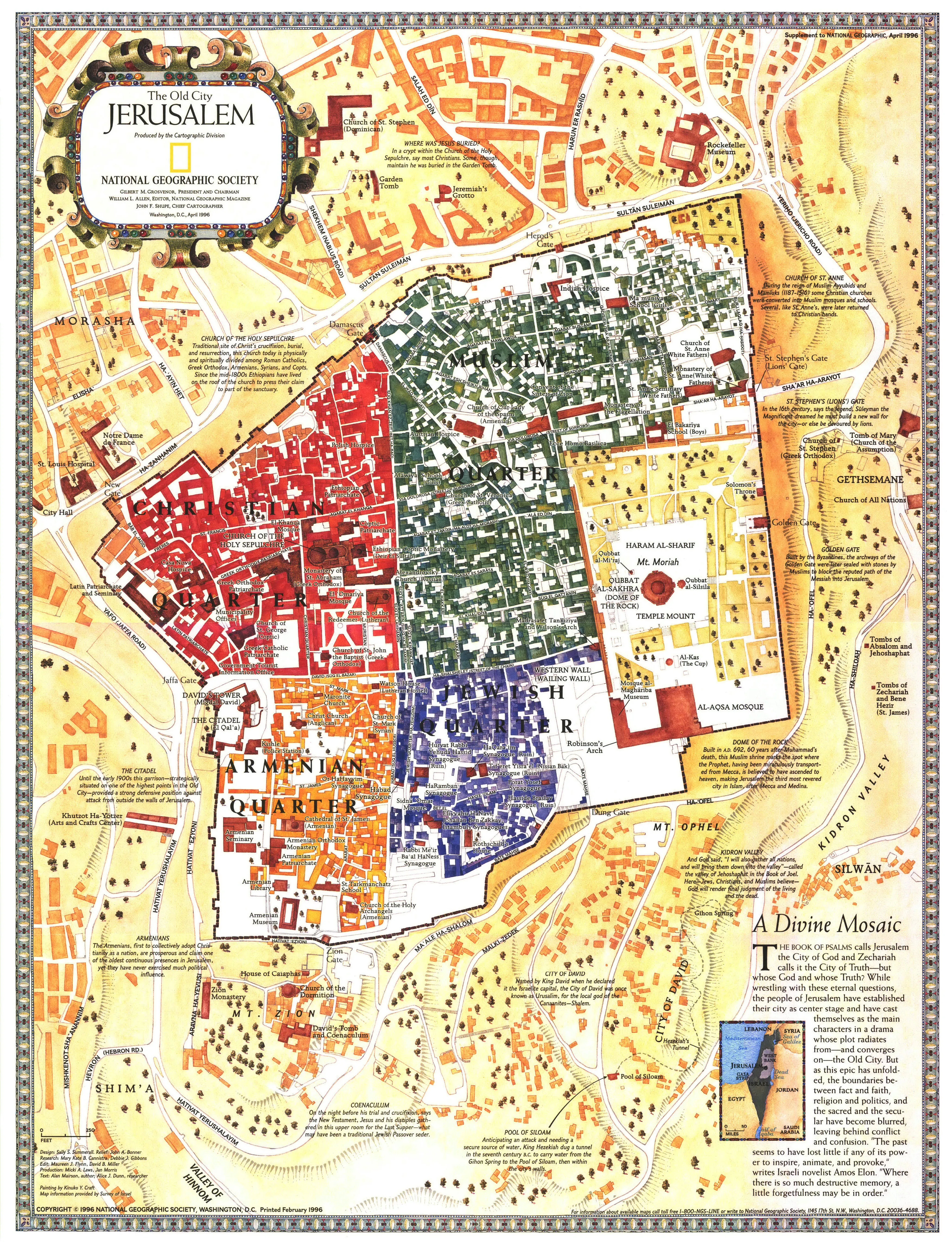
- Mapping from National Geographic
- Al-Aqsa Mosque
- Temple Mount
- Dome of the Rock
- Western Wall
- Church of the Holy Sepulchre
-
- Bethlehem
- buses available to travel from Jerusalem and it usually takes less than an hour
Videos
- ISRAEL First Impressions (one day in Tel Aviv) from Kara and Nate
- TEL AVIV TO JERUSALEM BY BUS (don’t make this mistake) from Kara and Nate
- JERUSALEM, ISRAEL’S OLD CITY (not what we expected) from Kara and Nate
- Tour in Bethlehem , Palestine from SOLO Production
- Travels in Israel - Mediterranean journey from DW Documentary
- JORDAN Travel Vlog | Jesus Was Baptized HERE (Jerash & Mt. Nebo) from Kara and Nate
- Floating in the DEAD SEA! UNREAL Experience
- Exploring The Lost City of PETRA | A Rollercoaster of Emotions
- Sleeping in a MARTIAN DOME | Wadi Rum, Jordan
Food
- Israeli cusisine
- street food
- appetizer
- gefilte fish eaten during Shabbat
- mains
- hummus
- msabbaha similar to hummus but different in texture
- shakshouka
- couscous
- cholent eaten during Shabbat lunch
- me’orav Yerushalmi
- pastry
Transportation
Rav-Kav
It is a smart card used as the main form of payment for public transportation in
Israel. It can be used to take the train or bus. If you take the bus, it is the
only form of payment accepted. The train connects Tel Aviv with major locations
throughout Israel, while buses cover a wide range of locations, both within and
outside Tel Aviv. At the train ststions, you can also purchase paper tickets
through the machine or with ticketing agent. The anonymous card (which doesn’t
require personal passenger information) can be purchased for a one-time payment
of 5 NIS. It can be purchased at tourist information centers, train stations,
and the airport. You can also buy it on board any bus for 10.90 NIS - this
includes the price of the card itself as well as a ride in the city. You must
load your card with money before boarding. There are also loading locations
available throughout the city, including tourist information centers,
“Tel-O-Fun” green bike stations, and designated stores and kiosks. A card can be
loaded with as much as needed. With 5.90 NIS, you can take as many buses as
you like within Tel Aviv as long as you don’t exceed a 90-minute time frame.
Afterwards, an additional amount is required.
Reference: Public Transportation
Free Weekend Transportation System
Free transportation services are now offered on Fridays and Saturdays in the Tel Aviv metropolitan area.
- The buses run approximately every half hour. On Fridays between the hours 5pm and 2am and on Saturdays between the hours 9:30am and 6pm.
- Real-time information and schedules in English can be found on
BuSofash and mobile apps such as
Moovit- note: electronic signs at bus stations do not present bus hours
- The buses and relevant stations are branded accordingly and feature dedicated maps.
- At this stage, the transportation service is offered free of charge and passengers are able to move freely from one bus line to another.
- Food and alcoholic beverages are not allowed on board, but water is ok.
Moniyot Sherut (service taxis)
It runs along the main roads in the city and throughout the country. Sheruts are in essence minivans that operate as shared taxis; they are generally yellow, with numbers on the windshield indicating their route, and they can transport about 10-12 people at a time.
Pricewise, sherut taxi fares are a set price and similar to bus fares. They usually reach their destination faster and tend to be less crowded. Sheruts operate both inter and intra-city routes and can be easily accessed from right outside the Central Bus Station.
By simply raising your hand, you can flag down a sherut and ask the driver to drop you off at any point along the route. You can hand the driver your fare as you get on the taxi, or you can take your seat and pass your money down to the driver. Not to worry-your change will be passed back to you. Note that while sheruts operate on Shabbat (Friday night and Saturday), fares will increase by a few shekels.
Sherut taxis generally follow public bus routes within the city, and are identified by numbers that signify their routes. The most common sheruts are the 4 & 5.
4Runs from the Tel Aviv Central Bus Station through Allenby Street and Ben Yehuda Street all the way up to the Reading Power Plant.5Runs from the Tel Aviv Central Bus Station through Rothschild Avenue, Dizengoff Center and Dizengoff Street up to Weitzman Street in the north. (Notice that the Sherut doesn’t go all the way to the Arlozorov train station, as does the number 5 bus).
Taxis
Local and inter-city taxi services are available to and from any point in the country. Fares within the cities are according to the meter. The fares for inter-city taxi services are standard fares set by the Ministry of Transport. It is recommended to verify the fare prior to entering the taxi. Taxis can be ordered by telephone from a local taxi station or stopped on the street. There is a standard starting fare for taxis. There are also additional charges for telephone orders and for each suitcase (which is not a handbag). Night rates, Saturdays and holidays are 25% more expensive than the normal fare. There is also additional fee for an airport drive. Drivers must operate the meter for rides within the city. It is advised to request the meter for inter-city rides, even if the driver suggests a fixed price at the beginning of the ride.
Mobile apps
Trains
It reaches airport, Tel Aviv-Yafo, Jerusalem, Haifa and Be’er-Sheva. It does respects the observance of Jewish Shabbat.
It takes less than 40 minutes to travel from Tel Aviv (Ha’Hagana) to Jerusalem (Yerushalayim).
History and politics
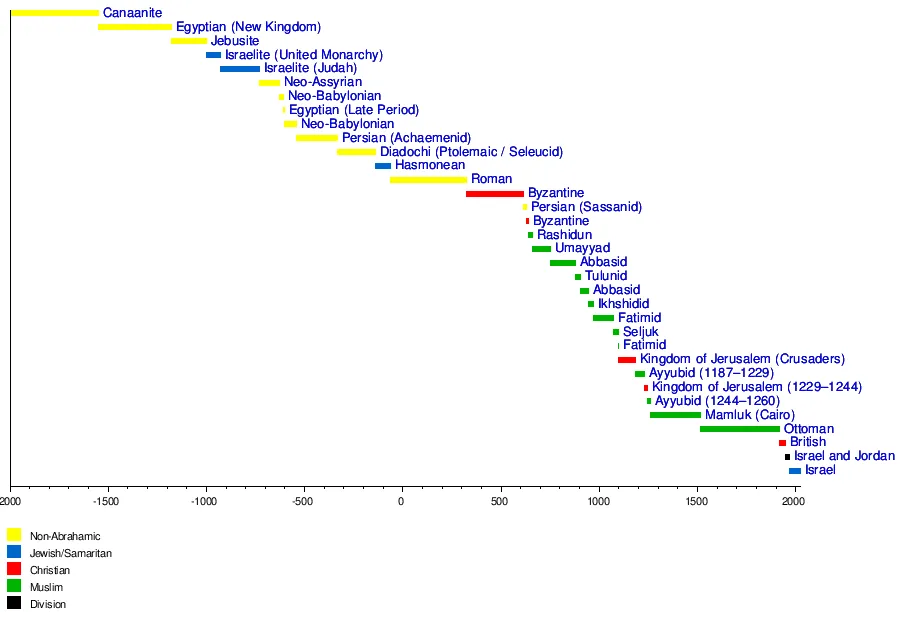
- Jerusalem
- The part of Jerusalem called the City of David shows first signs of settlement in the 4000BC, in the shape of encampments of nomadic shepherds.
- During the Israelite period, significant construction activity in Jerusalem began in the 900BC, and by the 800BC, the city had developed into the religious and administrative centre of the Kingdom of Judah.
- In 1538, the city walls were rebuilt for a last time around Jerusalem under Suleiman the Magnificent of the Ottoman Empire. Today those walls define the Old City.
- During the 1948 Arab–Israeli War, West Jerusalem was among the areas captured and later annexed by Israel while East Jerusalem, including the Old City, was captured and later annexed by Jordan.
- Israel captured East Jerusalem from Jordan during the 1967 Six-Day War and subsequently effectively annexed it into Jerusalem, together with additional surrounding territory.
- Ottoman period
- British Mandate (1917–1948)
- Jordanian and Israeli rule (1948–1967)
-
- The Israel-Palestine conflict: a brief, simple history from Vox
- Why Israelis and Palestinians both claim Jerusalem from Vox
- Who owns Jerusalem? from DW
- Israeli settlements, explained | Settlements Part I by Johnny Harris from Vox
- Why Israeli settlements don’t feel like a conflict zone | Settlements Part II by Johnny Harris from Vox
- Settlers are taking over East Jerusalem one house at a time by Johnny Harris from Vox
- What It’s Like to Grow Up in an Israeli Settlement | Op-Docs from The New York Times
- Jerusalem: Three religions, three families | Faith Matters from DW
Data SIM cards (Annatel via Airalo)
| Days | Data (GB) | Price (USD) |
|---|---|---|
| 30 | 20 | 22 |
| 30 | 10 | 18 |
| 30 | 5 | 13.5 |
| 30 | 3 | 11 |
| 7 | 1 | 5.5 |
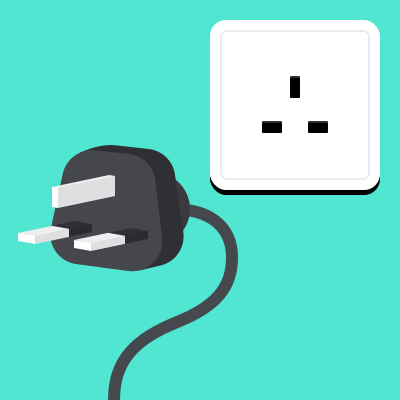
Electrical sockets


Other topics
- Languages
- Palestinians lives in the West Bank
- To see the holy sites and the Old City of Jerusalem, it is suggested to spend at least three days
COVID
- Tripperhead’s Somewhat Helpful Guide to: Departing Hong Kong
- no restrictions for tourists
- Covid-19 Guidance from Ministry of Health of Israel
- If you think you have COVID-19 symptoms, you should call the Ministry of
Health hotline on
*5400(when you hear the Hebrew message dial2,1,2). After a short assessment you will be forwarded to a designated Magen David Adom (MDA) unit. MDA will coordinate a testing location with you. Results for foreign nationals will be sent to the nearest Ministry of Health Unit. You should take note of how your name is spelt in Hebrew in the system as this will help with tracking results.
Safty and security
- Israel travel advice from
gov.uk
-
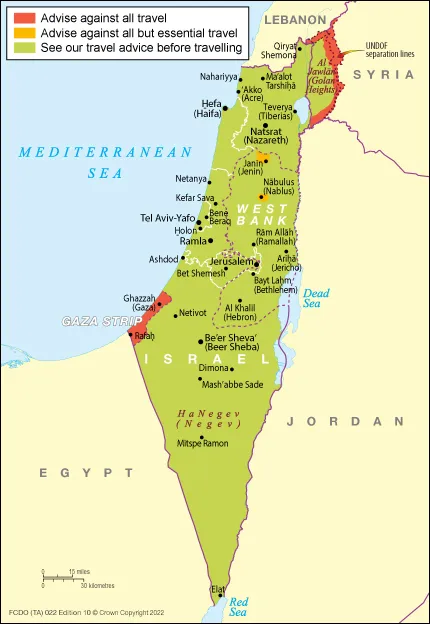
- You should check the local news before travelling to see if there have been recent clashes, be vigilant, avoid any large gatherings or demonstrations, avoid areas which have been the site of recent violence and follow the instructions of the local authorities
- There is a risk of increased tension around Friday prayers and on other religious holidays and anniversaries.
- How to act during an alert (siren sounds)?
-
- Jerusalem
- There are frequent demonstrations in many of the areas of the city visited by tourists including in and around the Old City (particularly at and around Damascus Gate, Herod’s Gate, Lion’s Gate and the Chain Gate), especially after Friday prayers. Some of these protests have led to violent clashes. Stay alert at all times in the Old City and leave the area if there is evidence of tension or unrest (for example if the shops in the souks (markets) suddenly begin to close their shutters). The entrances to the Old City may be subject to checks or closures.
- West Bank
- Expect road closures and numerous checkpoints across the West Bank. Travel in and out of the West Bank is not possible without passing through at least one Israeli military checkpoint. You will need a passport and immigration slip to go through these checkpoints.
- Map from UN inter-agency Access Coordination Unit
- The cities of Bethlehem, Ramallah and Jericho see large numbers of tourists including on organised tours and there have been no recent reports of any serious incidents involving foreigners. However, you should take care when travelling anywhere in the West Bank.
- Due to a significant number of road traffic accidents involving taxis in the West Bank, you’re advised not to use them where possible
- You should avoid using buses on the West Bank and keep in mind the difficulties and risks associated with travelling between Jerusalem/Ramallah via checkpoints and the risks associated with travelling along Route 60
- Recent terrorist attacks
